Code of Student Rights and Responsibilities
PDFSLCC MISSION, VISION, AND VALUES
MISSION
Salt Lake Community College is your community college. We engage and support students in educational pathways leading to successful transfer and meaningful employment.
VISION
Salt Lake Community College will be a model for inclusive and transformative education, strengthening the communities we serve through the success of our students.
VALUES
We don’t just state our values; we live them through dedicated, collective effort. Our values ground our future endeavors and help us realize our mission of being an open-access, comprehensive community college committed to the transfer education and workforce needs of our students.
- Collaboration–We believe we’re better when we work together.
- Community–We partner with our community in the transformative, public good of educating students.
- Inclusivity–We seek to cultivate an environment of respect and empathy, advanced by diverse cultures and perspectives.
- Learning–We learn as a college by building outstanding educational experiences for students and by supporting faculty and staff in their professional development.
- Innovation–We value fresh thinking and encourage the energy of new ideas and initiatives.
- Integrity–We do the right things for the right reasons.
- Trust–We build trust by working together in good faith and goodwill to fulfill the college’s mission.
Preamble
The reputation of the college and the college community depends in large part upon the behavior and academic achievement of its students. Students enrolled at the college are expected to conduct themselves in a mature, dignified, and honorable manner.
While enrolled at the college, students are subject to college jurisdiction. The college reserves the right to take disciplinary action against any student whose conduct, in the opinion of college representatives, is not in the best interests of the student, other students, or the college. Students who are disciplined should expect to find their sanctions enforced at all Salt Lake Community College campuses. All students are expected to abide by the following college rules of conduct. In the Code of Student Rights and Responsibilities, the term student is used to refer to:
- All persons taking SLCC courses, both full-time and part-time; and/or
- All persons who are not officially enrolled for a particular term but have a continuing relationship with SLCC or intend to enroll in the next term. This provision is intended to include within the definition of students, those persons enrolled in the spring and fall semesters who engage in misconduct during the summer; and/or
- All persons who are attending classes on a SLCC campus although they may be enrolled students in other higher education institutions; and/or
Student groups and organizations may be held collectively responsible when violations of this code by those associated with the group or organization have received consent or encouragement of the group or organization or of the group’s or organization’s leaders or officers.
- Student Rights
Salt Lake Community College recognizes its responsibility to support and uphold the basic freedoms and citizenship rights of all students within the context of the entire educational setting, including experiences both inside and outside the classroom. All students have the following rights:
- Rights in the Pursuit of Education
The classrooms, laboratories, libraries, studios, and other spaces are the essential learning environments of the college, and the freedom to learn in these environments should be promoted and encouraged by the college’s faculty and staff. The following statements have been developed in support of students’ rights in all learning environments within the college. Students shall have the right to:
- have reasonable access to faculty and staff, academic technology, classrooms, libraries, presentations, and other resources necessary for the learning process;
- have access to academic advising and clear expectations for degree and graduation requirements;
- have decisions related to the pursuit of their education made in a clear manner;
- learn in an environment that supports the freedom of self-expression and association;
- participate in an exchange of ideas, pursuant with their constitutional rights and the preamble of this code, free of conduct that impedes either a faculty member’s ability to teach or the student’s ability to learn;
- expect that faculty and staff members will be sensitive to students’ religious beliefs and observances, including an expectation that instructors will make reasonable arrangements, upon appropriate prior notice, when a student must miss an exam or other academic exercise resulting from the observance of a religious holiday (see Religious Accommodation Request Form); and
- study, work, and interact in an environment of professionalism, mutual trust and respect that is free of amorous or sexual advances by faculty or staff members. All amorous or sexual relationships between faculty/staff members and students are actively discouraged when the faculty or staff member has any professional responsibility for the student, even when both parties have consented or appear to have consented to the relationship (see SLCC, Consensual Relations Policy). Such professional responsibility encompasses both instructional and non-instructional contexts.
- Right to Freedom from Discrimination: Diversity Statement
- It is the policy of Salt Lake Community College to comply with all federal, state, and local authorities requiring nondiscrimination, including, but not limited to Title VI and VII of the Civil Rights Act of 1964, Executive Order No. 11246, 45 C.F.R. Part 90, the Civil Rights Restoration Act of 1987, Title IX of the Education Amendments of 1990 (ADA), the Age Discrimination Act of 1975, Genetic Information Nondiscrimination Act of 2008, and Utah’s Executive Order issued December 13, 2006.
- The college is fully committed to policies of equal employment and nondiscrimination and works to prevent any form of exclusion from participation in, denial of benefits of, or subject any individual to discrimination, harassment, or prejudicial treatment on the basis of race, color, national origin, sex, sexual orientation, gender identity, genetic information, disability, religion, protected veteran status, expression of political or personal beliefs outside of the workplace, or any other status protected under applicable federal, state, or local law.
- For more information or if you believe you have been subject to discrimination on the basis of sex, sexual orientation, or gender identity, please contact Salt Lake Community College’s Title IX coordinator:
Cindy Cole
4600 S Redwood Rd.
Technology Building Suite 222
Salt Lake City, UT 84123
(801) 957-4561
titleIX@slcc.edu - For more information or if you believe you have been subject to discrimination on the basis of disability or need assistance with an accommodation, please contact:
Students
Accessibility and Disability Services (801) 957-4659
You may also file a complaint with:
U.S. Department of Education–Denver Office
Office of Civil Rights (OCR)
Cesar E. Chavez Memorial Building
1244 Speer Boulevard, Suite 310
Denver, CO 80204-3582
Telephone: 303-844-5695
Fax: 303-844-4303; TDD 800-877-8339
Email: OCE.Denver@ed.gov
Website: www.ocrcas.ed.gov
- Right to Freedom from Harassment
- Salt Lake Community College is committed to maintaining the campus community as a place of work and study free from abuse, intimidation and harassment, where everyone is treated with respect, dignity, and courtesy. Conduct which disrupts, interferes with the safety of others, adversely affects, or otherwise interferes with the lawful functions of the college, or the rights of an individual to pursue an education at the college may be subject to college discipline.
- Salt Lake Community College complies with all Federal laws, rules and regulations, statutes and applicable Title IX programs; along with the State of Utah and appropriate local jurisdictions, the board of regents, board of trustees and the president’s executive cabinet.
- To encourage reporting of alleged sexual misconduct, relationship violence, and stalking violations, neither the complainants nor witnesses will face disciplinary action under section II.C of the Code of Student Rights and Responsibilities if they personally engaged in the unlawful or prohibited use of alcohol or drugs during the incident when the alleged violation occurred.
- Additionally, respondents will not face additional referrals for actions under section II.C of the Code of Student Rights and Responsibilities if they personally engaged in unlawful or prohibited use of alcohol or drugs during the incident when the alleged violation occurred.
- Amnesty applies only to the personal use of alcohol or drugs and does not extend to other potential violations of section II.C of the Code of Student Rights and Responsibilities or other college policy. For example, if the respondent provided alcohol or drugs to the complainant as a means of facilitating the alleged violation, the respondent may face additional disciplinary action.
- Right to Access Records
- Salt Lake Community College maintains an educational record for each student who is or has been enrolled at Salt Lake Community College.
- In accordance with the Family Educational Rights and Privacy Act (FERPA) of 1974, as amended, the following student rights are covered by the act and afforded to all students at Salt Lake Community College:
- The right to inspect and review information contained in the student’s educational records.
- The right to challenge the contents of the student’s educational records.
- The right to a hearing if the outcome of the challenge is unsatisfactory.
- The right to submit an explanatory statement for inclusion in the educational record if the outcome of the hearing is unsatisfactory.
- The right to prevent disclosure, with certain exceptions, of personally identifiable information.
- The right to secure a copy of the institutional policy.
- The right to file complaints with the Department of Education concerning alleged failures by Salt Lake Community College to comply with the provisions of the act. The name and address of the office that administers FERPA is:
Family Policy Compliance Office
U.S. Department of Education
400 Maryland Avenue, SW
Washington, DC 20202-8520
- Student Right to Know
- The 1990 Federal Student Right to Know Act requires colleges and universities to report to prospective and current students the persistence and graduation rates of full-time technical- certificate and degree-seeking students.
- The graduation rate is based upon program completion within 150 percent of time usually required for a full-time student. For technical certificate students, this is the number of full-time students graduating in three semesters.
- For associate degree students, this is the number of students graduating in six semesters. Information regarding SLCC’s compliance with the 1990 Federal Student Right to Know Act may be found on the college’s Website.
- Right to Freedom of Association, Expression, Advocacy, and Publication
- Students are free to form, join, and participate in groups or organizations that promote student interests, including but not limited to, groups or organizations that are organized for intellectual, religious, social, economic, political, recreational, or cultural purposes.
- In accordance with state and federal constitutions and college policy, the college recognizes the rights of all students to engage in discussion, to express thoughts and opinions, and to assemble, speak, write, publish, or invite speakers on any subject without college interference or fear of college disciplinary action.
- Students may engage in peaceful and orderly protests, demonstrations, and picketing in traditional public forums, specifically, outdoor areas of the college campus that do not substantially disrupt functions of the college. Such protests, demonstrations, and picketing are subject to appropriate regulation concerning time, place, and manner so long as the restrictions:
- are narrowly tailored to serve a significant institutional interest;
- are based on published, content-neutral, and viewpoint-neutral criteria;
- leave alternative channels for communication;
- do not restrict spontaneous and contemporaneous assembling in outdoor areas of the college campus; or
- do not restrict a person from freely engaging in lawful, noncommercial expressive activity in outdoor areas of the college campus.
- Demonstrations are a legitimate mode of expression, whether politically motivated or directed against the college administration, and will not be prohibited.
- Demonstrators, however, have no right to deprive others of the opportunity to speak or be heard, take hostages, physically obstruct the movement of others, or otherwise disrupt educational or institutional processes in a way that interferes with the safety or freedom of others.
- Students may be subject to disciplinary action when their actions cause, or are likely to cause, disruption or interference with the regular and essential operation of the college as outlined in section III of the student disciplinary procedures, of this code.
- Students who have questions about protests, demonstrations, or any other form of expression, should contact the dean of students office for more information.
- Students who publish student publications under college auspices have the right to be free of college censorship. Student editors and managers may be suspended or removed from their positions only for proper cause and by appropriate proceedings conducted by the organization responsible for the appointment of such editors and managers.
- Salt Lake Community College requires a student group or organization to register and be approved by the college. Student groups and organizations must comply with all federal, state and local laws, as well as college policies.
- A student, student group, or organization may be authorized to use college facilities for extracurricular activities, subject to the procedures established by the college.
- As constituents of the academic community, Salt Lake Community College students shall be free, individually and collectively, to express their views on issues of institutional policy and procedures which shall include the examination and discussion of issues of interest to them and expression of opinions both publicly and privately. They shall be free to invite and to hear persons of their choosing and to support causes by orderly means that do not substantially disrupt the regular and essential operations of the college.
- Right to Accommodation for Individuals with Disabilities
- The Disability Resource Center (DRC) staff seek to ensure that all students who meet eligibility requirements, as defined by college policy, receive the opportunity to learn to their fullest abilities.
- Reasonable accommodations for persons with disabilities will be made to ensure access to academic programs, services, and employment in accordance with section 504 of the Rehabilitation Act of 1973, the Americans with Disabilities Act of 1990, and the Americans with Disabilities Amendment Act based upon the policies and procedures established by the college.
- Right to Pregnancy Accommodations
- The College will not discriminate against or exclude any student from participating in any part of an educational program based on the student’s pregnancy, childbirth, false pregnancy, termination of pregnancy, or recovery therefrom.
- To request pregnancy accommodations, contact the Disability Resource Center at 801-957-4659, or submit a Pregnancy Accommodation Request Form.
- If a student is unsatisfied with an accommodation request, they may submit a formal complaint. Students must submit a formal complaint with:
Title IX Coordinator
EEO & Title IX Office
Taylorsville Redwood Campus, Technology Building, Suite 222
801-957-4561
TitleIX@slcc.edu - Students may request an accommodation, file a complaint, and appeal an accommodation decision for a pregnancy-related condition using the procedures in Student Pregnancy Accommodation Department Rule.
- Rights of Students in the Judicial Process
- Students have the right to file a complaint if they believe any of their rights, as defined in this code, have been violated by another student in the college community.
- A student making a complaint under the provisions of this code should expect that the college will make a good faith attempt to determine the validity of the complaint.
- The responding party/respondent and the reporting party/complainant, are not entitled to be present while the individuals who are responsible for determining and deliberating the merits of the complaint.
Rights of a reporting party/complainant include:
- The student has the option of being present in all aspects of a formal hearing in which witnesses provide evidence relating to the charge.
- The student has the right to an advisor, as defined in section V.A of this code.
- The college will disclose the final results of any disciplinary proceeding to complainants as permitted by the provisions of state and federal laws. Specifically, victims of crimes that involve physical violence or a sex offense will be notified of disciplinary proceeding outcomes. In cases where the victim is deceased because of the alleged crime, the victim’s next of kin will be notified of the disciplinary proceeding outcomes.
Rights of a Responding Party/respondent (alleged offender):
- A student charged with violating this code has the right to a fair and reasonable process for handling the charges.
- The student has the right to be informed of the procedures that will be used in adjudicating the charges against him/her, including but not limited to, notice of the charges, deadlines associated with stages of the process, the kinds of evidence that may be submitted at each stage, and the availability of appeals processes, if any.
- The student has the right to be present during those portions of any formal hearing in which witnesses provide evidence relating to the charge.
- The student has the right to an advisor, as defined in section V.A of this code.
- The student who is participating in a formal hearing at which evidence may be submitted is entitled to request the college make a good faith attempt to compel the attendance of witnesses, compel the production of documents, and provide a reasonable time period within which requests for witnesses and documents can be submitted and acted upon.
- Rights of Students as College Employees
- A student’s rights and responsibilities as an employee of the college are governed by the procedures of the work unit and by the applicable personnel policies of Salt Lake Community College.
- Students should contact their immediate supervisor or Human Resources for information. All personnel policies are available on the Salt Lake Community College Website.
- Rights in the Pursuit of Education
- Student Responsibilities
Just as students have rights, they also have responsibilities. Salt Lake Community College recognizes its responsibility to support and uphold the basic freedoms and citizenship rights of all students, and it expects students to be responsible for the following:
-
- Uphold and follow all codes of conduct, including this code, relevant codes and bulletins of respective schools, professional programs or professional societies, and all rules applicable to conduct in class environments, including distance education courses and programs and college-sponsored activities, including off-campus clinical, field, internships, athletics, in-service experiences, activities utilizing college technology or other college approved activities.
- Obey all applicable college policies and procedures and all local, state, and federal laws.
- Respect the learning environment which includes, but is not limited to attending class, completing class assignments, and coming to class prepared.
- Plan a program of study appropriate to their educational goals. This may include selecting a major field of study, choosing an appropriate degree program within the discipline, planning class schedules, and meeting the requirements for the degree.
- Use of college property and facilities in support of their education while being mindful of the rights of others to use college property and facilities.
- Maintain and regularly monitor their college accounts including e-mail and student finance (bursar) accounts.
- Uphold and maintain academic and professional honesty and integrity.
- Be responsible for their behavior, and respect the rights and dignity of others both within and outside of the college community.
- Be accountable for all applicable responsibilities, including those associated with academic programs. While this code applies to all students, some academic programs have additional student responsibilities associated with it that may be based upon accreditation standards and professional standards, as well as compliance with federal and state laws. It is the responsibility of the student to inquire with their academic department regarding any additional responsibilities that may apply to them.
- Academic Misconduct, Academic Integrity & Professional Behavior
- Academic misconduct is defined as any activity that undermines the academic integrity of the institution. Faculty members are responsible for maintaining the academic integrity of the institution. Academic integrity is expected of all students. Faculty and the college may sanction a student for academic misconduct.
- Salt Lake Community College recognizes academic integrity as a fundamental principle of collegiate life. The credibility of the college’s educational programs rests upon the foundation of student learning and integrity. Students who misrepresent their academic work violate the rights of their fellow students and undermine the faculty member’s authority and ability to assess learning.
- Faculty members are also responsible for determining appropriate and professional behavior connected with academic course work associated with clinical, field, or internship experiences off college property. Further, some academic programs have additional student responsibilities associated with them that may be based upon accreditation standards and professional standards, as well as compliance with federal and state laws.
- The college, therefore, views any act of academic dishonesty or unprofessional behavior as a serious offense requiring disciplinary measures, including failure for the exam or specific course work, course failure, removal from an academic program, suspension, and expulsion from the college. In addition, an act of academic dishonesty may have unforeseen effects and lead to a formal process outside the college.
- Violations of academic integrity and professional behavior include, but are not limited to, the following acts:
- Aiding Cheating or Other Acts of Academic Dishonesty: Providing material or information to another student with the knowledge that this material or information will be used to deceive faculty. Students are strongly encouraged to safeguard passwords and passcodes that grant access to college resources, databases, email, and other systems. Sharing of passwords and passcodes that lead to academic dishonesty is grounds for disciplinary action.
- Cheating: Unauthorized use of notes or study aids, or acquiring information from another student’s papers, on an examination; obtaining a copy of an examination or questions from an exam prior to taking the exam; altering graded work with the intent to deceive another person to do one’s work and then submitting as one’s own name; allowing another to take an examination in one’s name; submitting identical or similar papers for credit in more than one course without obtaining prior permission from the instructors of all the courses involved.
- Data Misrepresentation: Fabricating data; deliberately presenting in an assignment data that was not gathered in accordance with assigned guidelines or deliberately fabricated; or providing an inaccurate account of the method by which the data was gathered and generated.
- Plagiarism: Presenting within one’s own work the ideas, representations, or words of another person without customary and proper acknowledgment of that person’s authorship is considered plagiarism. Students who are unsure of what constitutes plagiarism should consult with their instructors. Claims of ignorance will not necessarily excuse the offense.
- Unauthorized Access to Computerized Academic or Administrative Records or Systems: Unauthorized access to computerized academic or administrative records or systems means viewing or altering the college’s computer records without authorization; copying or modifying the college’s computer programs or systems without authorization; releasing or dispensing information gained through unauthorized access; or interfering with the use or availability of computer systems or information. Also, when college-sponsored activities are held at locations owned or managed by other institutions or organizations, the unauthorized use, viewing, copying or altering of those institutions’ computer records, systems, or programs would similarly constitute a violation of academic integrity.
- Unprofessional or Inappropriate Behavior within a Clinical, Field, or Internship Experience: Conduct that is considered to be lewd, indecent, obscene, inappropriate, and/or non-compliant with professional or accreditation standards; or a violation of clinical or other affiliated site expectations or guidelines; or a violation of federal or state laws.
- Personal Misconduct Involving Computers/Technology
- Network files: Salt Lake Community College network files are provided to students for their academic work. These files are not private and are subject to review for compliance with the college’s acceptable use policy for technology.
- Unauthorized Use of Computers and Technology: Theft or other abuse of computer facilities and resources including:
- unauthorized entry into a file, to use, read, or change the contents, or for any other purpose;
- unauthorized transfer of a file, including peer-to-peer file sharing;
- use of another individual’s identification and/or password;
- use of computing facilities and resources to interfere with the work of another student, faculty member, and/or college official;
- use of computing facilities and resources to send obscene or abusive messages;
- use of computing facilities and resources to interfere with normal operation of the college’s computing system;
- use of computing facilities and resources in violation of copyright laws; or
- any violation of the college’s computer use policy.
- Personal Misconduct on College Property
The college may sanction a student for the following acts of personal misconduct that occur on college property including, but not limited to, academic and administration buildings, recreational facilities, and other college-serviced properties:
- Aiding/Participating in a Riot: Aiding, encouraging, or participating in a riot.
- Committing College Funds: Committing college funding, including student clubs or organizations, without written approval, will result in the student’s being responsible for the money owed, the student’s being removed from the club or organization, and disciplinary action being taken. No student shall enter into a contract with an outside agency using the name of the college. Contracts entered into in violation of this rule shall be the personal responsibility of the student.
- Copyright Infringement: Conduct or activities that violate federal copyright laws including, but not limited to, the piracy of written or electronic media, are not permitted.
- Damage to Property: Damage to or destruction of college property or the property belonging to others.
- Dishonesty: Dishonest conduct including, but not limited to, false accusation of misconduct; forgery, alteration, or misuse of any college document, record, or identification; and giving to a college official information known to be false.
- Disorderly Conduct: Conduct that is considered to be obstructive or disruptive that interferes with teaching, research, administration, or other college or college-authorized activities.
- Endangerment: Actions that endanger one’s self or others in the college community or the academic process.
- Explosive Devices: Unauthorized possession, use, manufacture, distribution, or sale of illegal fireworks, incendiary devices, or other dangerous explosives.
- Failure to Comply: Failure to comply with the directions of authorized college officials (staff, faculty, administrators) in the performance of their duties, including failure to identify oneself when requested to do so; failure to comply with the terms of a disciplinary sanction; refusal to vacate a college facility when directed to do so.
- Falsification of Academic Records or Documents: Falsification of academic records or documents includes, but is not limited to, altering any documents affecting academic records; forging signatures or falsifying information of an official academic document such as a grade report, ID card, library card, or any other official college letter or communication.
- Falsification of Identity: Assuming another person’s identity or role through deception or without proper authorization. Communicating or acting under the guise, name, identification, email address, signature, or other indications of another person or group without proper authorization or authority.
- Falsification of Information: Knowingly initiating, transmitting, filing, or circulating a false report or warning concerning an impending bombing, fire, or other emergency or catastrophe; or transmitting such a report to an official or an official agency.
- Fire/Safety Equipment: Unauthorized setting of fires on college property; unauthorized use of or interference with fire equipment and emergency personnel.
- Gambling and Betting: Unlawful gambling and betting, in any form, at the college or at any college sponsored event is prohibited.
- Harassment: Harassment, defined in Part I (c) of the code.
- Inappropriate Conduct: Conduct that is considered to be lewd, indecent, obscene or inappropriate.
- Interference with Dissemination of Information: Interfering with the dissemination of other college regulations, policies, or rules. Examples of such regulations include, but are not limited to, college computing policies, registration policies, etc.
- Intimate Partner Violence: includes any act of violence or threatened act of violence that occurs between individuals who are involved or have been involved in a sexual, dating, spousal, domestic, or other intimate relationship. Intimate Partner Violence may include any form of Personal Misconduct under this code, including Sexual Assault, Stalking, and Physical Abuse.
- Littering: Intentional littering, including, but not limited to, unapproved distribution of materials, handouts, flyers, etc. are prohibited.
- Minors on Campus: Minors are not permitted to be on Salt Lake Community College property without direct supervision by a parent or guardian, with the exception of college sponsored childcare centers, minors who are enrolled in Salt Lake Community College courses, or other approved activities. Minors are not permitted in classrooms at any time unless enrolled in the course or approved by the course faculty member or by administrative staff.
- Obstruction: Intentionally obstructing or blocking access to college facilities, property, or programs.
- Parking: Students are expected to comply with parking regulations. Parking spaces for persons with disabilities and visitors’ areas are reserved for those purposes. Vehicles improperly parked in those areas may be ticketed or towed at the owner’s expense.
- Physical Abuse: Physical abuse of any person, including the following:
- The use of physical force or violence to restrict the freedom, action, or movement of another person or to endanger the health or safety of another person.
- Physical behavior that involves an expressed or implied threat to interfere with an individual’s personal safety, academic efforts, employment, or participation in college-sponsored extracurricular activities or causes the person to have a reasonable apprehension that such harm is about to occur; or
- Physical behavior that has the purpose or reasonably foreseeable effect of interfering with an individual’s personal safety, academic efforts, employment, or participation in college-sponsored extracurricular activities or causes the person to have a reasonable apprehension that such harm is about to occur.
- Possession of Firearms: Possession of any weapon, potential, or facsimile of a weapon on any college property contrary to law or college policy; possession or display of any firearm on college property, except in the course of an authorized activity.
- Possession/Distribution/Consumption of Alcohol: Unauthorized possession, use, or supplying alcoholic beverages to others contrary to law or college policy.
- Salt Lake Community College prohibits:
- Public intoxication, use, or possession of alcoholic beverages on college property;
- Providing or possessing alcohol contrary to law.
- Student organizations that serve or permit possession of alcoholic beverages at student organization functions, on or off campus, may be disciplined if violations of alcoholic beverage laws or of college regulations occur. Individual students who plan, sponsor, or direct such functions also may be subject to sanctions.
- Salt Lake Community College prohibits:
- Possession/Distribution/Use of Illegal Drugs or Controlled Substances: Unauthorized possession, manufacture, sale, distribution, or use of illegal drugs, any controlled substance, or drug paraphernalia. This may also include being under the influence of illegal drugs or unauthorized controlled substances.
- Recording of Hearings, Meetings, and Academic Instruction: Audio recording communications, including lectures or other academic events are prohibited unless prior permission is received by the appropriate faculty member or college administrator. A student with a disability may seek a reasonable accommodation from the Disability Resource Center to allow audio recordings. Designated administrative meetings and student hearings may be audio recorded so long as the recording device is in plain view and those in attendance are aware the communication is being audio recorded. This section does not apply to monitoring or recordings pursuant to court order or other legitimate law enforcement activities (see Governor’s Executive Order, State of Utah, January 27, 1993).
- Sale/Distribution of Firearms/Controlled Substances: Sale of any firearms or controlled substance from college property or using college facilities, including computer accounts and telephones; intentional possession of a dangerous article or substance as a potential weapon.
- Sexual Assault: consists of Sexual Contact and/or Sexual Intercourse that occurs without Affirmative Consent.
- Sexual Contact is:
- any intentional sexual touching, however slight,
- with any object or body part (as described below),
- performed by a person upon another person, and
- that is without affirmative consent and/or by force.
Sexual Contact includes:
- intentional touching of the breasts, buttocks, groin or genitals, whether clothed or unclothed, or intentionally touching another with any of these body parts; or
- making another touch you or themselves with or on any of these body parts.
- Sexual Intercourse is:
- any penetration, however slight;
- with any object or body part (as described below);
- performed by a person on another person; and
- that is without affirmative consent and/or by force.
- Sexual Intercourse includes:
- vaginal penetration by a penis, object, tongue, or finger;
- anal penetration by a penis, object, tongue, or finger; or
- any contact, no matter how slight, between the mouth of one person and the genitalia of another person.
- Affirmative Consent is:
- informed (knowing),
- voluntary (freely given), and
- active (not passive) meaning that, through the demonstration of clear words or actions, a person has indicated permission to engage in mutually agreed-upon sexual activity.
- Affirmative Consent cannot be obtained by Force. Force includes:
- the use of physical violence;
- threats;
- intimidation; and/or
- coercion. (see Student Sexual Misconduct Policy for additional information)
- Sexual Contact is:
- Sexual Exploitation: is purposely or knowingly doing any of the following:
- causing the incapacitation of another person (through alcohol, drugs, or any other means) for the purpose of compromising that person’s ability to give affirmative consent to sexual activity;
- allowing third parties to observe private sexual activity from a hidden location (e.g., closet) or through electronic means (e.g., Skype or livestreaming of images);
- engaging in voyeurism (e.g., watching private sexual activity without the consent of the participants or viewing another person’s intimate parts (including genitalia, groin, breasts or buttocks) in a place where that person would have a reasonable expectation of privacy);
- recording or photographing private sexual activity and/or a person’s intimate parts (including genitalia, groin, breasts or buttocks) without consent;
- disseminating or posting images of private sexual activity and/or a person’s intimate parts (including genitalia, groin, breasts or buttocks) without consent;
- prostituting another person; or
- exposing another person to a sexually transmitted infection (STI) or virus without the other’s knowledge.
- Sexual Harassment: is defined as unwelcome sexual advances, requests for sexual favors, and other intimidating verbal or written communications or physical conduct of a sexual nature when:
- Submission to such conduct is made either explicitly or implicitly a term or condition of an individual's employment, education, academic pursuits, or participation in a college activity (often referred to as quid pro quo harassment); or
- Such conduct affects or has the purpose of unreasonably interfering with an individual’s employment, education, living environment, or participation in a college activity by creating an intimidating, hostile, or offensive working or learning environment.
- A hostile environment can be created by persistent or pervasive conduct or by a single or isolated incident, if sufficiently severe. The more severe the conduct, the less need there is to show a repetitive series of incidents to prove a hostile environment, particularly if the conduct is physical. A single incident of sexual assault, for example, may be sufficiently severe to constitute a hostile environment. In contrast, the perceived offensiveness of a single verbal or written expression, standing alone, is typically not sufficient to constitute a hostile environment.
- Sexual Misconduct: Sexual Misconduct encompasses a broad range of behavior, including sexual assault, sexual exploitation, intimate partner violence, stalking, sexual or gender-based harassment, complicity, and retaliation.
- Smoking/E-Cigarettes: Smoking in public buildings, which includes college facilities, violates the Utah Indoor Clean Air Act (Rule r.392-510). This rule and its regulations also applies to e-cigarettes. State statue (26.38.2) defines an e-cigarette as an electronic device that provides a vapor of nicotine or other substance and which simulates smoking through its use or through inhalation of the device. It is an oral device that is composed of a heating element, battery, or electronic circuit and marketed, manufacture, distributed, or sold as an e-cigarette; e-cigar; e-pipe; or any other product name or descriptor. Smoking is prohibited within 25 feet of any entrance or ventilation access of any building on any college site except where federal laws apply and greater distances are posted.
- Solicitation: College policy requires that individuals or organizations seeking the use of campus facilities or scheduling activities to solicit funds must first obtain written approval from the appropriate college official. College rules and regulations govern fundraising activities, the money collected, and the use of the money collected by the fundraising activities. Misrepresentation or misuse will result in the student being responsible for the money owed to an institution or individual, the student’s being removed from the club or organization, and the student’s facing disciplinary action. The student is also accountable for compliance with state and federal laws and regulations.
- Stalking/Hazing/Cyber-Bullying: Stalking, hazing, or cyber-bullying of any kind whether the behavior is carried out verbally, physically, electronically, or in written form.
- Stalking occurs when a person engages in a course of conduct directed at a specific person and involves sexual or gender-based harassment under circumstances that would cause a reasonable person to fear bodily injury or to experience substantial emotional distress.
- Course of conduct means two or more acts, including but not limited to acts in which a person directly, indirectly, or through third parties, by any action, method, device, or means, follows, monitors, observes, surveils, threatens, or communicates to or about another person, or interferes with another person’s property. Substantial emotional distress means significant mental suffering or anguish.
- Hazing is defined as any conduct that subjects another person, whether physically, mentally, emotionally, or psychologically, to anything that may endanger, abuse, degrade, humiliate, or intimidate the person as a condition of association with a group or organization, regardless of the person’s consent or lack of consent.
- Cyber-Bullying is defined as any conduct that subjects another person, whether physically, mentally, emotionally, or psychologically, to anything that may endanger, abuse, degrade, humiliate, or intimidate the person through the use of electronic or digital media.
- Threatening or Intimidating Behavior: Engaging in or encouraging any behavior or activity that threatens or intimidates.
- Travel Policies and Procedures: All student travel, whether as a class or club activity, must be approved through appropriate college officials. Each student participating must review and sign required forms prior to traveling as part of any college sponsored event (for more information, visit the Driver Safety Program.
- Unauthorized use of College Facilities: Unauthorized entry, use, or occupancy of college facilities.
- Unauthorized use of College Property: Unauthorized taking, possession, or use of college property, services, or the property or services of others.
- Unauthorized use of College Resources: Unauthorized release or use of any college access codes for computer systems, duplicating systems, and other college equipment.
- Verbal Abuse: Verbal abuse of another person, including the following:
- An expressed or implied threat to:
- interfere with an individual’s personal safety, academic efforts, employment, or participation in college-sponsored activities and that under the circumstances causes the person to have a reasonable apprehension that such harm is about to occur; or
- injure that person, or damage his/her property; or
- Fighting words that are spoken face-to-face as a personal insult to the listener or listeners in personally abusive language inherently likely to provoke a violent reaction by the listener or listeners to the speaker.
- An expressed or implied threat to:
- Violation of State or Federal Law: A violation of any state or federal criminal law.
- Violence: The use against any person of any mental, physical, written, or verbal abuse that threatens, is perceived as threatening or endangers the health, safety, and wellness, or promotes hatred or prejudice towards others is prohibited. This also includes fighting and/or other disruptive behavior, which includes any action or threat of action which endangers the peace, safety, or orderly function of the college, its facilities, sponsored events on or off-campus, or individuals engaged in any approved activity.
- Personal Misconduct Not on College Property
The college may sanction a student for acts of personal misconduct or criminal acts that are not committed on college property if the acts arise from college activities that are being conducted off the college’s campuses, or if the misconduct undermines the security of the college community or the integrity of the educational process or poses a serious threat to self or others.
- Salt Lake Community College is committed to the promotion of a civil community both on campus and off campus.
- Salt Lake Community College regards off-campus activity, including but not limited to, college-sponsored events, as an integral part of a student’s academic, personal, and professional growth. Thus, the college recognizes the right of all students to expect that the college will subject individuals to the same responsibilities and disciplinary procedures when conduct:
- Adversely impacts the college’s mission, or the tenets of this code, such as altering academic transcripts, harassment of any kind, trafficking of academic works, use of a computer or other electronic device to obtain unauthorized access to information;
- Presents a clear danger to the personal safety of any person or the protection of any person’s property, such as alcohol and drug offenses, arson, battery, fraud, hazing, participation in group violence, rape, sexual assault, stalking, or theft;
- Violates policies of an academic program and related facilities, including but not limited to, an off-campus clinical, field, internship, or in-service experience, or an overseas study program.
-
- Student Disciplinary Procedures
-
- Salt Lake Community College disciplinary procedures will be used to determine responsibility for violations of the Code of Student Rights and Responsibilities and determine the appropriate consequences for violations of policy.
- The college’s disciplinary procedures are separate and distinct from any formal legal proceedings.
- The procedures for imposing academic and disciplinary sanctions are designed to provide students with due process, procedural fairness, and developmental growth opportunities; to ensure equal protection for all students; and to provide for the imposition of similar sanctions for similar acts of misconduct.
- At the same time, the procedures reflect the need to be concerned about the individual student involved in a particular case. The procedures, therefore, provide that the imposition of disciplinary sanctions must also be based upon a consideration of all circumstances in a particular case, including a student’s prior record of misconduct, if any.
- For the purposes of this code, calendar days are based upon the college’s academic calendar and excludes weekends, holidays, and official college break periods and closures.
- Calendar days will be counted during active academic terms. Calendar days in-between academic terms will not be counted due to limited faculty/staff/student availability during break periods.
- The timelines established within this code outlines the maximum timeframes for each step.
- The college’s ability to proceed with substantive determinations and actions in a particular case shall not be impaired by minor deviations from these procedures that do not have the effect of preventing a student from responding fully to a charge of misconduct.
- This code governs activities on all campuses of Salt Lake Community College. The procedures described below are intended to be used only for determining whether violations of the code occurred.
- The student rights and responsibilities described in the code are specific to academic misconduct, computer/technology misconduct, personal misconduct on college property, and personal misconduct not on college property and should not be used for general complaints, grade appeals, or other students/faculty/staff concerns.
- General Principles
- The college intends that proceedings under the code not only resolve charges of misconduct, but also have educational benefit for the students involved.
- Every effort will be made to ensure that students are encouraged to speak for themselves throughout the process of addressing alleged code violations.
- Students may have an advisor, including at their own expense an attorney, who accompany them at any or all stages of the process (see section V.A of this code).
- A student with a disability substantially affecting communication or a student who cannot effectively communicate in the English language may seek a reasonable accommodation from the office of the dean of students to allow an advisor or interpreter to present or translate the proceedings.
- Except when a student poses serious and substantial risk of harm to self, to others, to property, or to the continuing function of a program or the college and as outlined in the summary action section of this document, no sanctions shall become effective until after opportunities for appeal under the code have been exhausted.
- Coursework performed while misconduct proceedings are underway, however, shall be considered conditional. Conditional work may be affected or eliminated based on a final finding of misconduct or sanction imposed.
- This may result in loss of course credit, a delay in the awarding of a degree, or revocation of a degree that was awarded prior to a final decision in the misconduct proceedings.
- If either academic or personal misconduct is discovered that may impact degree conferral or graduation, the vice president for Student Affairs may elect to withhold posting of the degree pending completion of misconduct proceedings.
- If, after a degree has been conferred, the college determines that the student committed academic misconduct prior to the conferral, the college may revoke the degree.
- When an allegation of academic misconduct prior to degree conferral is made, the college shall conduct an investigation to determine whether misconduct occurred, and if so, whether to recommend revocation of the degree to the provost for Academic Affairs.
- The college shall determine the procedures to be followed in conducting its investigation. The college shall make every reasonable effort to notify the person regarding the misconduct allegation and permit the person to respond to the allegation.
- In instances when the student poses serious and substantial risk of harm to self, to others, to property, or to the continuing function of a program or the college, the faculty member in charge may remove a student from an on-campus or off-campus activity or program, as outlined in the Faculty Prerogatives in Maintaining A Safe, Supportive, And Effective Learning Environment Policy.
- Off-campus activities and programs include, but are not limited to: clinical, field, internship, athletic, international study programs, and in-service experiences as outlined in the Faculty Prerogatives in Maintaining A Safe, Supportive, And Effective Learning Environment Policy. In instances where a faculty member invokes this college policy, the college may also utilize the procedures outlined in this code to determine whether a violation of college policy occurred.
- Additionally, a student may be removed summarily based on the terms of any agreement between the college and a third party regarding student placement or academic experience.
- Removal from an academic activity or program on-campus or off-campus becomes part of the student’s disciplinary record only after a final determination under these procedures that the student engaged in academic or personal misconduct.
- When a student is dismissed from a clinical program or other third party placement based on the terms of an agreement with that third party, the student may not grieve the dismissal under the code.
- Students have the right to appeal findings of misconduct and the imposition of sanctions. The purpose of giving students a right of appeal is to allow them to bring to the attention of another authority on campus significant factual and procedural errors that reasonably may bear on the finding of misconduct or the sanction imposed.
- All notices specified in the procedures for addressing academic and personal misconduct shall be made in writing, which may include electronic mail.
- As used in the student disciplinary procedures section of this code, the terms faculty, faculty member, and staff includes all those who teach or are employed by the college including, but not limited to: full-time faculty, program directors, associate deans, academic deans, visiting, part-time, and adjunct faculty, administrative staff, support staff, and other employees.
- Any deadline set out in these procedures may be extended by the relevant authority only for good reason shown.
- The college strives to provide an educational and professional environment that allows individuals to engage in their daily activities in a safe, healthy, and secure manner. Local, state, or federal law enforcement officials will be notified of anyone violating local, state, or federal laws. Violators shall be subject to prosecution by the appropriate law enforcement officials.
- Anyone found in violation of college regulations shall be subject to disciplinary action by the college through due process procedures for student conduct violations.
- Procedures for Addressing Academic Misconduct/Academic Integrity Issues:
- The academic misconduct procedures address two key issues:
- whether misconduct has occurred, and if so,
- what sanctions are appropriate.
- As set out more fully below, various people and offices play specific roles in resolving these two issues. Whether misconduct has occurred in a particular course, and if so, whether a particular academic sanction (failing grade, repeating an assignment, etc.) is an appropriate response to a finding of misconduct in the course.
- When alleged violation(s) of academic misconduct/academic integrity occur in a distance education course, the department where the course originates will determine whether a violation of college policy occurred and will also determine the outcomes, including sanctions, as outlined in this code.
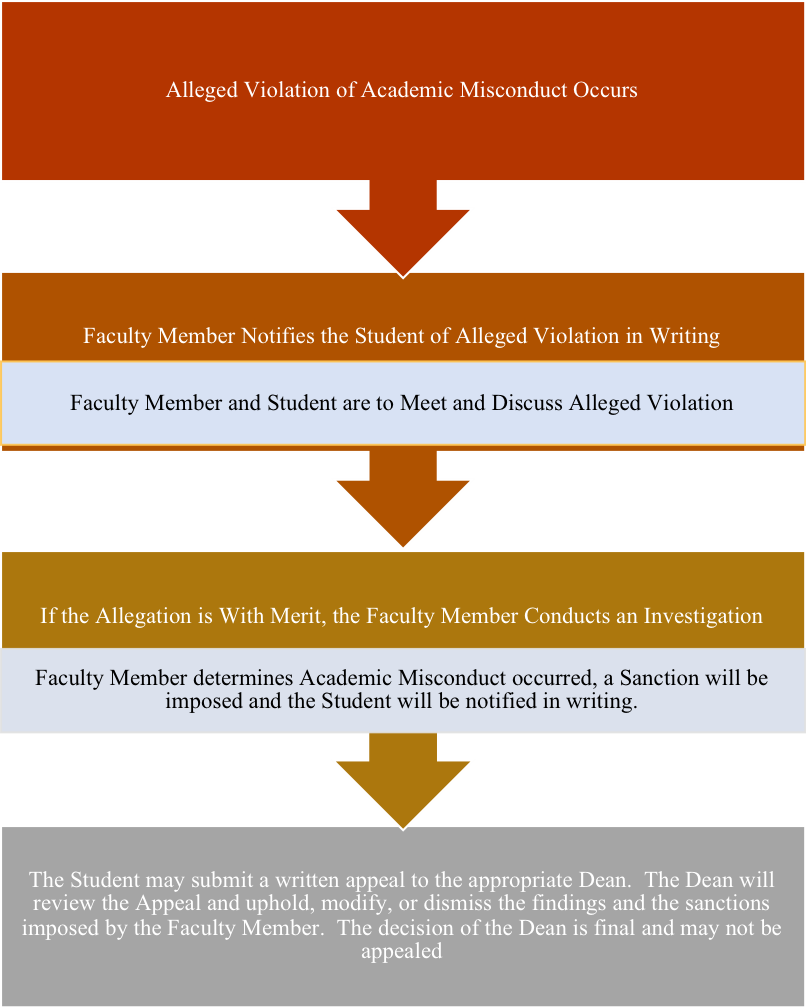
- Academic Misconduct Procedures: The procedures for handling students who are suspected of violations of academic integrity are as follows:
- Step One: Inform Student of Allegations
- A faculty member who suspects a student of academic dishonesty must inform the student, in writing of the alleged infraction within five calendar days after the discovery of the violation.
- The faculty member shall offer to meet with the student to discuss the violation and provide evidence of his/her allegations.
- The faculty member may inform and/or request assistance from his/her program director/associate dean.
- In cases where the student claims the alleged dishonesty is a manifestation of his/her disability, the faculty member will involve the EEO/Civil Rights investigator or the students’ Disability Resource Center advisor in any subsequent deliberative due process.
- Step Two: Conduct Investigation/Possible Sanction(s)
- Within five calendar days after informing the student of the alleged infraction, the faculty member may investigate to further substantiate the allegation(s), including, meeting with the student to discuss the violation/provide evidence of his/her alleged misconduct.
- If the student chooses not to meet with the faculty member and/or the student cannot be reached, a decision will be rendered in the student’s absence.
- Following the investigation, if there is sufficient merit to the allegation(s), the faculty may impose sanction(s) for academic dishonesty. The faculty member will notify the student of the sanction(s).
- Step Three: Decision and Appeal Process
- Within five calendar days after the imposition of a decision and possible sanction(s) by the faculty member, the student may submit a written appeal to the appropriate dean.
- The dean will review the findings from the decision made by the faculty member and render his/her decision.
- The dean will notify the student, in writing, of his/her decision to uphold, modify or dismiss the decision and possible sanction(s) imposed by the faculty member.
- The decision of the dean is final and may not be appealed.
- The dean of students office will be notified upon any finding of academic misconduct and sanctioning for purposes of documenting and monitoring a student’s compliance with any imposed sanction(s).
- Additionally, in cases where academic dishonesty has been repeated by a student or is of an especially serious nature, the dean of students may recommend the imposition of additional sanctions, up to and including suspension and/or expulsion from the college.
- Step One: Inform Student of Allegations
- The academic misconduct procedures address two key issues:
- Sanctions for Academic Misconduct
Faculty, program directors, associate deans, deans, and the provost for Academic Affairs are authorized to impose any one or a combination of the following sanctions after finding a student responsible for acts of academic misconduct. The possible sanctions include, but are not limited to:
- verbal warning and reprimand;
- restriction of privileges, such as access to lab facilities, library facilities, or testing centers;
- failure of the exam, quiz, project or other assessment;
- failure for the course;
- withdrawal from the course; or
- withdrawal from the academic program
- Procedures for Personal Misconduct
- Disciplinary proceedings for acts of personal misconduct, excluding alleged Title IX violations (see the Student Sexual Misconduct Policy), are governed by the following procedures:
- Disciplinary proceedings for an act of personal misconduct that is committed simultaneously with an act of academic misconduct are governed by the following procedures unless the dean of students and the faculty member involved agree otherwise.
- Any person may make a report that a student has committed an act of personal misconduct. The report must be submitted in writing to the office of the dean of students.
- The dean of students may designate representatives to conduct fact-finding investigations, to serve as conduct hearing officers, and to recommend disciplinary action.
- After reviewing a report, the dean of students has the discretion to decide whether disciplinary proceedings should be instituted.
- A student has the right to view his/her disciplinary file with proper notice to the dean of students.
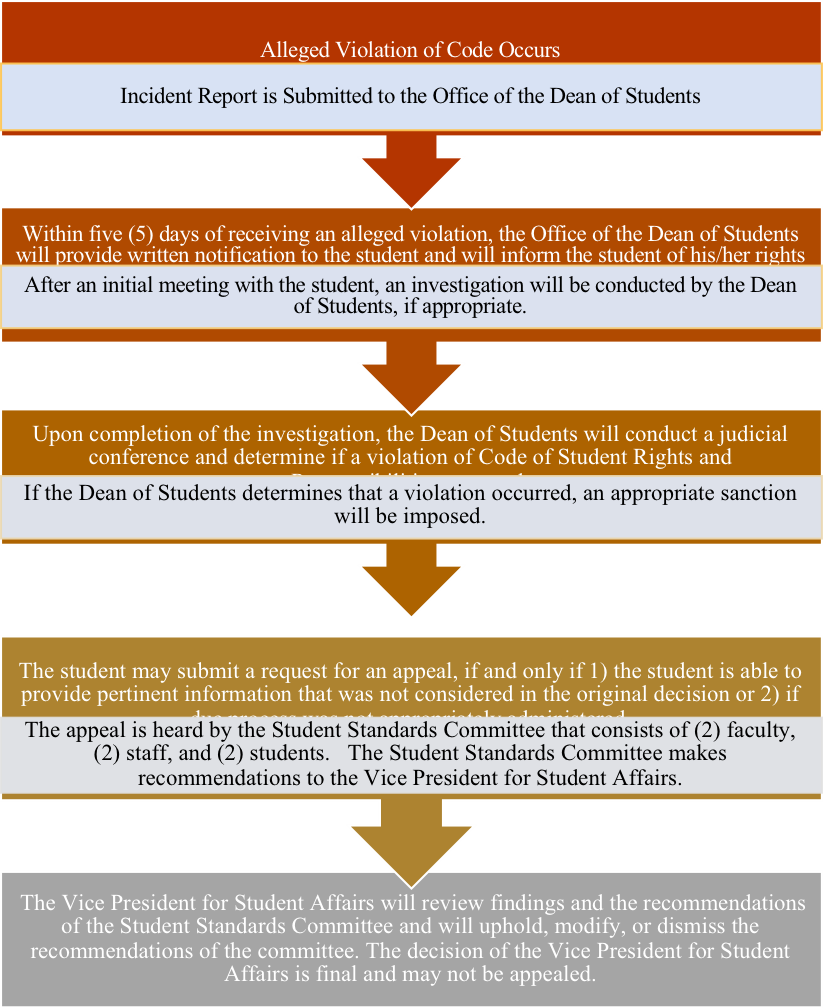
- Personal Misconduct Procedures:
- Step One: Inform Student of Allegations (Informal Process)
- Within five calendar days of the reported allegation, the dean of students will provide written notice to the student.
- The notice will include a description of the alleged act(s), the time and place if known, and a summary of the information upon which the alleged misconduct is based.
- The student will be informed of the name(s) of the complainant(s) and any witnesses, except in the case of sexual harassment, sexual assault, sexual violence or perceived or direct threat.
- The student is expected to meet with the dean of students within the time frame indicated in the written notice.
- The student will be given an opportunity to present his/her case during the meeting with the dean of students.
- If the student chooses not to meet with the dean of students and/or the student cannot be reached, a decision will be rendered in the student’s absence and the student forfeits his or her right to any appeal.
- Step Two: Conduct Investigation/Possible Sanction(s) (Informal Process)
- After the initial meeting, the dean of students will then conduct an investigation if the allegations are with merit.
- Following the investigation, the dean of students will determine the findings of the investigation and will impose a sanction(s) if appropriate.
- The student will be notified in writing of the findings, the sanction(s), and their rights to request an appeal as defined by the code.
- Step Three: Appeal Process (Formal Process)
- If the student rejects the findings and/or sanction(s) of the dean of students, he/she may request an appeal to the Student Standards Committee.
- The student must submit a written request for an appeal to the office of the dean of students within five calendar days of receiving notification of the findings and sanction(s).
- A request for an appeal is granted by the Student Standards Committee Chair, if:
- the student is able to provide pertinent information that was not considered in the original decision, or
- if due process was not appropriately administered.
- Step One: Inform Student of Allegations (Informal Process)
- The Student Standards Committee shall be comprised of five members:
- two faculty members, including the chair of the Student Standards Committee, nominated by the Faculty Senate and appointed by the provost for Academic Affairs;
- one student and one staff member appointed by the vice president for Student Affairs, and the executive vice president of the SLCC Student Association.
- The Student Standards Committee shall act as an impartial hearing board and shall schedule the appeal hearing within five calendar days of the written request. Delays, if needed, will be communicated to all parties.
- During the Student Standards Committee appeal hearing, the student shall have the right to present evidence and witnesses. Any evidence having reasonable value as to a relevant fact may be admitted and considered.
- Unless prohibited by reasonable circumstances, each party shall provide to the committee copies of the documents and other real evidence they intend to submit and a list of witnesses they would like to call during the appeal hearing to the office of the dean of students no later than five working days prior to the hearing.
- Neither the rules of civil procedure nor the formal rules of evidence govern these hearings.
- At the conclusion of the hearing, the Student Standards Committee chair will submit the committee’s findings and recommendation to the vice president for Student Affairs.
- Within five calendar days after receiving the recommendation from the Student Standards Committee, the vice president for Student Affairs shall dismiss, modify or uphold the recommendation of the Committee.
- The decision of the vice president for Student Affairs is final and may not be appealed.
- All formal hearings for personal misconduct, excluding alleged Title IX violations and investigations (see the Student Sexual Misconduct Policy), shall incorporate the following procedural requirements:
- The presiding officer of the appeals board shall maintain order and make all rulings necessary for the fair, orderly, and expeditious conduct of the hearing.
- Members of an appeals board shall be free from conflicts of interest that reasonably would appear to impair their ability to evaluate a misconduct matter in a fair and impartial manner.
- Normally, all parties must be present in person. The appeals board may allow for presence in formal hearings by electronic means, when warranted by special circumstances.
- Both sides shall have the opportunity to make opening and closing remarks regarding the charge of misconduct.
- Both sides may present witnesses and submit other information regarding the charge of misconduct, subject to the presiding officer’s determination of relevance. At all times, the appeals board may question witnesses and ask for the submission of additional information.
- A student’s failure or refusal to speak on his/her own behalf at a hearing shall not be considered an admission of responsibility for the alleged act.
- In personal misconduct proceedings, the college bears the burden of proving, with clear and convincing evidence that the student engaged in misconduct. In appeal proceedings, the burden of proof lies with the student.
- The hearing body’s decision shall be based solely on information obtained prior to and during the hearing, except that, if the appeals board asks for additional information to be provided after the hearing, the appeals board may include that information in its decision making, as long as both sides have had a chance to review and respond to the additional information either in a resumption of the hearing or in writing.
- Appeal proceedings will be audio recorded and maintained for 30 days after the hearing.
- Deliberations will be private and not audio recorded.
- Recommendations of an appeals board shall be made by majority vote.
- Sanctions for Personal Misconduct
Sanctions: The dean of students is authorized to impose any one or a combination of the following sanctions after finding a student responsible for acts of personal misconduct. Student disciplinary record retention guidelines are indicated below. If a student has more than one incident on file, the incident to be kept on file the longest will determine the length of time all records are kept.
- Reprimand and Warning. A student may be given a reprimand accompanied by a written warning that the student may receive additional sanctions if the student engages in the same misconduct again or commits any other violation of this code. A reprimand and warning will remain a part of a student’s disciplinary record at least until he/she graduates.
- Reflective Activity. A student may be required to complete a reflective activity, such as writing a letter of apology or other written activity, which demonstrates the student’s learning and increased understanding of the college’s expectations regarding behavior.
- Administrative Withdrawal. A student may be administratively withdrawn from any or all courses during the semester in which the violation of college policy occurred. An administrative withdrawal will remain a part of a student’s disciplinary record at least until he/she graduates.
- Disciplinary Probation. A student may be placed on disciplinary probation for a specified period of time under conditions specified in writing with a warning that any violation of the conditions or any further acts of misconduct may result in additional disciplinary sanctions, including suspension or expulsion from the college. As a condition of probation, the student may be required to participate in a specific program, such as a counseling program or an alcohol education program, or to provide a specific service, such as the repair or restoration of any property damaged or taken by the student. A record of any disciplinary probation will remain a part of a student’s disciplinary record for five years after a student graduates.
- Restitution. A student may be required to pay the cost for the replacement or repair of any property damaged by the student. If the student fails to pay the cost or make the repairs, the student may be subjected to additional sanctions, including suspension or expulsion. A record of any restitution that a student is required to pay will remain a part of a student’s disciplinary record until he/she graduates.
- Participation in a specific program. A student may be required to participate in a specific program, such as a counseling program, a program designed to stimulate good citizenship within the college community, an alcohol education program, anger management or any other activity which would foster civic engagement. If the student fails to participate in the program as directed, the student may be subjected to additional sanctions, including suspension or expulsion. The student must provide the college with verification of program completion and evidence of personal well-being. Verification of program completion must be from a certified agency or appropriately certified health care provider or mental health counselor. A record of participation in any specific program that a student is required to complete will remain a part of a student’s disciplinary record until he/she graduates.
- Provision of a specific service. A student may be required to provide a specific service, such as the repair or restoration of any property damaged or taken by the student. If the student fails to provide the service as directed, the student may be subjected to additional sanctions, including suspension or expulsion. Completion of a specific service will remain a part of a student’s disciplinary record until he/she graduates.
- Suspension. A student may be prohibited from participating in all aspects of college life for a specified period of time (some portion of which may be deferred at the discretion of the dean of students). When a student is suspended from the college, the suspension applies to all campuses of the college. The dean of students is required to notify the Office of the Registrar and Academic Records to indicate the suspension on all copies of the student’s academic transcript. When the term of the suspension has ended, the Registrar will remove the notation from the student’s transcript. A record of the term of suspension will remain a permanent part of the student’s disciplinary record.
- Expulsion. A student may be dismissed from the college permanently. When a student is expelled from the college, the expulsion applies to all campuses of the college. The dean of students is required to notify the Office of the Registrar and Academic Records to indicate the expulsion on all copies of the student’s academic transcript. Furthermore, the student may not thereafter petition for readmission to the college. A record of expulsion will remain a permanent part of the student’s disciplinary record.
- Deferred Sanction. Sanctions of expulsion from and/or suspension from Salt Lake Community College may be deferred for a period of time not to exceed one year, with the provision that lesser sanction/s be completed and/or no further violations are committed within that period of time. If the student does not consent to the determination of responsibility or the sanction imposed, the student may request a hearing before the Student Standards Committee, depending on the level at which the deferred and lesser sanctions were imposed. If the deferred sanction is imposed, the following apply:
- If the lesser sanction(s) is/are completed in the time period assigned, the deferred sanction will not be implemented.
- If the lesser sanction(s) cannot be completed in the time period assigned due to medical, academic, or personal reasons, the student may apply, in writing, to the dean of students for an extension of that time period. The written request must be submitted at least three calendar days prior to the end of the time period. With their applications for an extension, students must present documentation of the personal, academic, or medical reasons they were unable to meet the deadlines, and they must show that they have completed a significant portion of their lesser sanction(s). The dean of students will deliver a decision about the extension to the student within 14 calendar days after receipt of the request.
- If the lesser sanctions are not completed in the time period assigned and no extension to the time period is requested or granted, or the student is found responsible for a new violation, the deferred sanction will automatically go into effect, and the student will have no further opportunity to appeal the deferred sanction.
- Deferred suspensions that are put into effect will begin in the semester in which the lesser sanction deadline was not met, or in which a new violation occurred. If the suspension is to include more than one semester, it will include the semester in which the lesser sanction deadline was not met or the new violation occurred, plus the subsequent semester/s.
- A student who is suspended risks losing all fees and grades for the semester in which the suspension is implemented.
- A record of a deferred sanction will remain a part of a student’s disciplinary record for five years after the student graduates (or permanently if the suspension has been implemented).
-
- Summary Action
- Student
- A student may be summarily suspended and summarily excluded from college property and programs pending an investigation by the dean of students.
- The dean of students, in consultation with the vice president for Student Affairs, may act summarily without following the hearing procedures established by this section if the dean of students and vice president for Student Affairs are satisfied that the student’s continued presence on the campus constitutes a serious threat of harm to the student or to any other person on the campus or to the property of the college or property of other persons on the college campus.
- A student who is summarily suspended and excluded from the college shall be required to leave the property of the college immediately and shall be notified that he/she will thereafter be treated as a trespasser if he/she returns to college property. Within 24 hours after the student is summarily suspended, a written notice must be sent to the student by certified mail informing the student of the following:
- That the student has been summarily suspended from the college
- That the student may not be present on college property
- That the student will be considered a trespasser if he/she returns to college property
- The reasons for the summary suspension and the exclusion from college property
- The student’s right contained within the Code of Student Rights and Responsibilities and their due process rights.
- Allegations of misconduct filed against a student who has been summarily suspended will be adjudicated by the office of the dean of students, within five days of receiving notice of the summary suspension. Procedures to be followed for summary suspension are outlined under section III.C of this code.
- The student shall thereafter be permitted at the discretion of the dean of students to enter the college campus only for the limited purpose of participating in the disciplinary process.
- The dean of students may require that the student be escorted to and from the proceedings by a college security officer.
- Misconduct by Student Organization or Athletic Team
- A complaint that a student organization or athletic team has committed an act of academic or personal misconduct may be filed against the student organization or athletic team and/or against individual members of the organization or athletic team. The complaint may be filed by any person.
- A complaint against a student organization or athletic team and/or individual members of the organization or athletic team must be submitted in writing to the dean of students.
- If the complaint is against a student organization or athletic team, the dean of students has the authority to initiate disciplinary proceedings against the organization or athletic team.
- Complaints against individuals are handled according to section A. Academic Misconduct, and section B. Personal Misconduct.
- Student
- Miscellaneous Judicial Procedure Information
- Advisors
- A person charged, a victim, or anyone providing testimony is entitled, at his/her expense, to be accompanied by an advisor, including an attorney, or support person of his/her choice.
- An advisor, including an attorney or support person is limited to the role of advising during the informal process of a personal misconduct proceeding. The advisor, including an attorney, or support person may not participate in the informal proceedings, may not question witnesses during an informal proceeding, and may not make any statements during informal proceedings.
- However, at formal hearings, the student’s advisor, including an attorney, may actively advise their student during the formal hearing, may provide opening and closing statements; and may question witnesses during the course of the formal hearing as allowed by the hearing committee.
- Should a student like an advisor, including an attorney to actively participate in a formal hearing, the student must provide written notice to the dean of students at least 72 hours prior to the scheduled hearing.
- A student with a disability affecting communication or a student who cannot effectively communicate in the English language may seek a reasonable accommodation from the dean of students to allow an advisor or interpreter to present or translate the proceedings.
- Student Appeal of a Grade
- When a student believes the final grade he/she received in a course is inaccurate, he/she should make an appointment with the instructor who issued the grade or status and explain the reason for this belief.
- This process must be initiated within 30 calendar days of receiving the grade. The instructor and the student should make every effort to resolve the issue. It is expected that most, if not all, misunderstandings will be resolved at this level.
- If the grade or status issue is not resolved with the faculty member, the student meets with the appropriate program director or associate dean. If the grade or status issue is not resolved with the appropriate program director or associate dean, the student may appeal in writing, to the appropriate Academic dean.
- The Academic dean will review the appeal and render a decision based upon the student’s written appeal.
- The decision of the Academic dean is final and may not be appealed.
- Regional Accreditation Statement
Salt Lake Community College is accredited by the Northwest Commission on Colleges and Universities, http://www.nwccu.org.
Northwest Commission Colleges and Universities
8060 165th Avenue, N.W.
Suite 100
Redmond, WA 98052
(425) 558-4224 (voice)
(425) 376-0596 (fax) - SafeUT Crisis Text & Tip Line
- The SafeUT Crisis Text and Tip Line is a statewide service that provides real-time crisis intervention through confidential two-way communication with SafeUT crisis counselors through the SafeUT Mobile App, phone number, or website.
- The SafeUT Services are provided through the University of Utah’s Crisis Center at the University Neuropsychiatric Institute (UNI) and all interactions are handled by licensed clinicians as part of their crisis responsive services.
- Students who call or start a crisis chat or text through the mobile app or web will connect directly to a UNI crisis counselor at the UNI CrisisLine.
- SafeUT may provide college administrators with crisis tips or reports when necessary or as required by law.
- If there is sufficient identifying information in the tip or report and there is a credible substantial risk of harm to the campus community and/or individual, the college may take reasonable measures to keep the campus community safe, including but not limited to investigating the tip or report or forwarding the tip or report to law enforcement officials.
- Acknowledgment
This Code of Student Rights and Responsibilities contains language, concepts, processes, and ideas taken directly from Indiana University’s Code of Student Rights and Responsibilities and has been done so with the permission of the Indiana University Board of Trustees and Office of Student Ethics.
- Advisors
Date of last cabinet review: February 28, 2023
The originator of this policy & procedure is the dean of students. Questions regarding this policy may be directed to the originator by calling 801-957-4776.