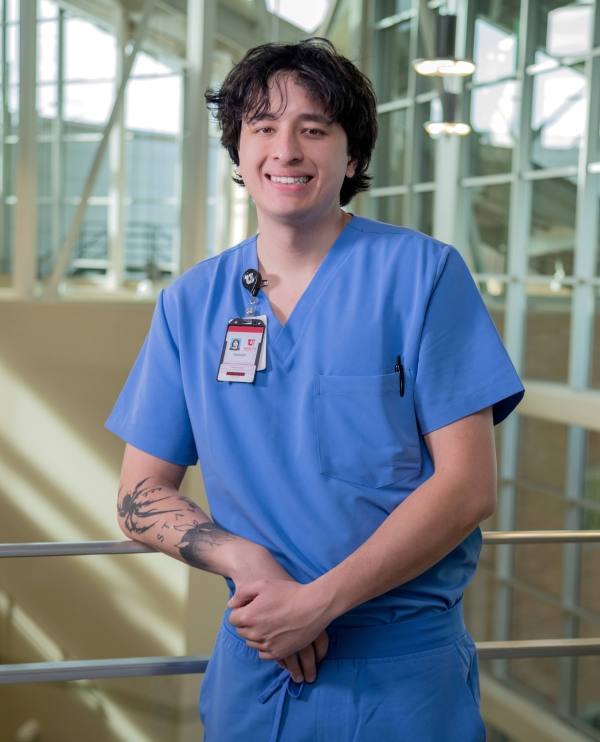
From Global Traveler to Surgical Technician
Parker Hale’s path to the Surgical Technology program at Salt Lake Community College (SLCC) has been anything but conventional. As the son of a military family, Parker was born in Utah but moved shortly after. Parker spent his formative years overseas in France and then moved across the United States in places from New Hampshire to Colorado, where he graduated high school.
The international experience taught him adaptability, a skill that serves him well in the rigorous surgical tech program. When he’s not immersed in his studies, you can find Parker enjoying the outdoors, ascending a cliff or shredding down a mountain of snow. This love for intense hands-on activities is what initially drew him to a trade.
“I worked in construction for a little while, and I really liked the hands-on aspect of that job,” Parker explains. “But I wanted a more fulfilling career—something with an impact on the community. Working towards a better goal, in my opinion, is what matters.”
The surgical technology program at SLCC is very intense. Parker, currently in his first semester, describes his schedule as a repeating cycle: mornings are spent in clinicals at the hospital, followed by classes running from 1:30 p.m. to 8:00 p.m., Monday through Wednesday. This exhaustive schedule leaves little room for balancing work and academics.
“I’m not sure how I would handle working full-time and also going through this program, without the Metallica Scholarship,” he admits.
Supported by Metallica’s foundation All Within Our Hands, the scholarship he received from University of Utah Health has made a big difference for Parker. When he learned the band was sponsoring scholarships, he was thrilled. Receiving financial support means he doesn’t have to worry about working while in the program and can dedicate himself fully to his studies. “It was a big blessing to be able to do this while I’m not having to worry about the financial stress,” he shares.
The funding also directly benefits the learning environment, equipping the SLCC lab with state-of-the-art tools that mimic a professional operating room (OR). This familiarity is crucial, as the surgical tech’s primary role is to manage the sterile field and ensure the surgical team has everything they need, often under extreme pressure.
Parker specifically points to the dedicated equipment. “We have two scrub sinks, which are known to be super expensive, and multiple stations with identical surgical tools,” he says. The constant repetition in the lab—sometimes the same procedure for three hours at a time—is designed to build muscle memory.
“It’s all about familiarity,” Parker notes. “When we are in that actual surgery, we aren’t relying on a PowerPoint presentation. We repeat it over and over so it’s going to be helpful for when we start working.”
After completing the one-year program, Parker plans to work at the University of Utah Hospital for two to three years to gain experience. From there, he hopes to explore becoming a travel surgical tech, or potentially specializing in areas like cardiovascular, orthopedic, or neurosurgery.
To those considering a change or a technical program, Parker advises extensive research. “It’s never too late to go to college. I was out of school for three to four years to work, and I was intimidated at first, but you usually get those skills and habits back once you start doing it again.”
He extends his thanks directly to Metallica: “A big thank you for this opportunity. I will forever be grateful to the band and the Foundation.”