STEM Talks
The STEM Talks is a series of short seminars hosted by instructors, students (both current and former), as well as others from outside of the college. The purpose of these talks is to provide students who attend them with an understanding of how STEM can actually be applied in the real world, particularly with examples not often discussed in general STEM courses. The talks also provide an avenue for the host to talk about topics that personally interest them with regard to STEMematics.
The talks were designed to encourage students to return to in-person classes after the COVID pandemic. The STEM Talks were instituted by mathematics Associate Professors Bryan Wilson and Rob Woodward in the Spring of 2023. Since then, attendance for the talks have grown more and more, demonstrating that students want to learn why STEM matters to them and they want to see how it can actually be used.
STEM Talks are hosted every Fall and Spring semester with about 3 or 4 talks planned each semester, typically near the end of each month. Each talk is planned to last about an hour. All talks are given in-person, there is no option for tuning in online.
Upcoming STEM Talks:
March 2026
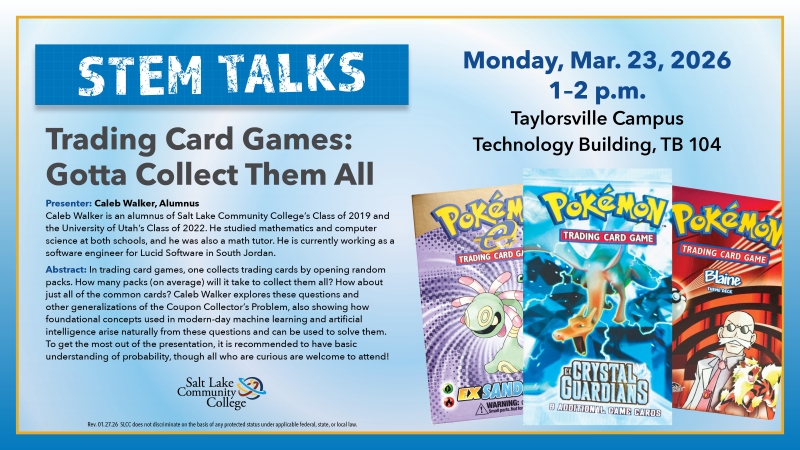
Trading Card Games: Gotta Collect Them All
Monday, March 23, 2026
1 - 2 P.M. | Technology Building, TB 104
Presenter: Caleb Walker
Abstract: In trading card games, one collects trading cards by opening random packs. How may packs (on average) will it take to collect them all? How about just all of the common cards? Caleb Walker explores these questions and other generalizations of the Coupon Collector's Problem, also showing how foundational concepts used in modern-day machine learning and artificial intelligence arise naturally from these questions and ca be used to solve them. To get the most out of the presentation, it is recommended to have basic understanding of probability, though all who are curious are welcome to attend!
April 2026
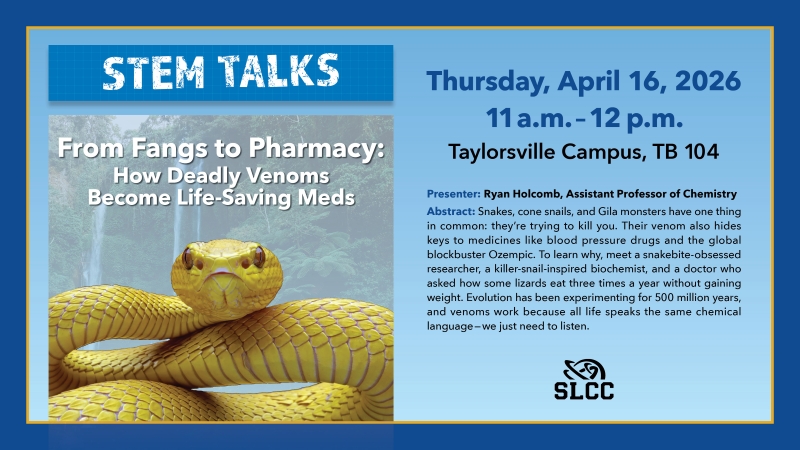
Trading Card Games: Gotta Collect Them All
Thursday, April 16, 2026
11 A.M. - 12 P.M. | Technology Building, TB 104
Presenter: Ryan Holcomb, Assistant Professor of Chemistry
Abstract: Snakes, cone snails, and Gila monsters have one thing in common: they're trying to kill you. Their venom also hides keys to medicines like blood pressure drugs and the global blockbuster Ozempic. To learn why, meet a snakebite-obsessed researcher, a killer-snail-inspired biochemist, and a doctor who asked how some lizards eat three times a year without gaining weight. Evolution has been experimenting for 500 million years, and venoms work because all life speaks the same chemical language - we just need to listen.
Questions? Contact: