Past Math Fun Talks
February 2026
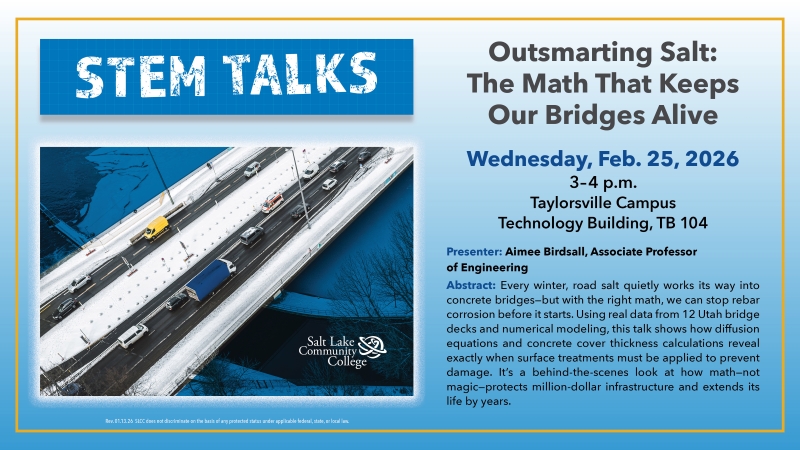
Outsmarting Salt: The Math That Keeps Our Bridges Alive
Wednesday, February 25, 2026
3 - 4 P.M. | Technology Building, TB 104
Presenter: Aimee Birdsall
Abstract: Every winter, road salt quietly works its way into concrete bridges—but with the right math, we can stop rebar corrosion before it starts. Using real data from 12 Utah bridge decks nd numerical modeling, this talk shows how diffusion equations and concrete cover thickness calculations reveal exactly when surface treatments must be applied to prevent damage. It's a behind-the-scenes look a how math-not magic-protects million-dollar infrastructure and extends its life by years.
November 2025
The STEMperature is Rising!
Monday, November 24, 2025
2 - 3 P.M. | Technology Building, TB 104
Presenter: John Flood
Department: Engineering
Abstract: Energy is at the root of chemistry, giving rise to everything from the Northern Lights to the Spring Thaw. Come explore what energy looks like from a molecular perspective, the ways energy is transferred in chemistry, and the out-of-this-world scale of heat that makes chemistry what it is.
October 2025
Inverse Mathematics
Wednesday, October 22, 2025
3 - 4 P.M. | Technology Building, TB 104
Presenter: Jesse Shelkey
Department: Engineering
Abstract: A talk on inverse Mathematics providing a conceptual discussion and fundamental applications. This will lead to conceptual understanding of current applications. Concluding the discussion with Inverse Tumor Temperature Reconstruction of Human Hyperthermia Treatments.
April 2025
Mathematical Invariance: The more things change...
Thursday, April 24, 2025
3 - 4 P.M. | Technology Building, TB 110
Presenter: Bryan Wilson
In a process where many things are changing over time, it is often illuminating to notice and pay close attention to the things that are NOT changing.
What do they reveal to us about the nature of the process? How can we take advantage of this knowledge?
Professor Bryan Wilson explores some invariants mankind has taken advantage of for centuries, as well as giving some examples of their use in solving some mathematical puzzles and games.
This talk is accessible to students of ALL math levels, although a few portions will have some advanced math (1050).
March 2025
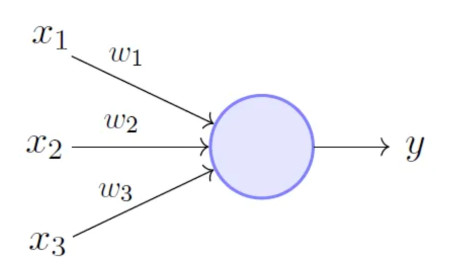
Perceptrons
Wednesday, March 26, 2025
1 - 2 P.M. | Technology Building, TB 110
A perceptron is an abstraction of a neuron, which is a cell in the nervous system used to communicate and process signals. A perceptron operates by taking multiple input values, multiplying each by a corresponding weight, summing those weighted inputs together with a bias, and then applying an activation function to produce a binary output, essentially making a simple decision based on whether the weighted sum exceeds a certain threshold; it is considered the basic building block of artificial neural networks and thus is central to understanding artificial intelligence or AI.
This Math Fun Talk will focus on understanding how a perceptron learns. We will explore the mathematics of the perceptron training algorithm both geometrically and algebraically.
Presenter: Jason Underdown
This talk will be structured for all students in Math 1010 or above, but all are welcome to attend.
February 2025
Math and Public Health
Thursday, February 27, 2025
4:15 - 5:15 p.m. | Technology Building, TB 110
Abstract: How do bacteria replicate? How do health departments track the spread of disease? In this talk, we’ll explore The math of how disease spreads. How exponential growth, logarithmic scales and basic statistics help us understand and control outbreaks. We’ll break down how diseases spread and show how math is crucial for managing public health.
Presenter: Courtney Fenlon
This talk will be structured for all students in Math 1010 or above, but all are welcome to attend.
January 2025
Prime Number Patterns: Finding Order in Chaos
Wednesday, January 29, 2025
3:30 - 4:30 p.m. | Technology Building, TB 110
Prime numbers are the foundation of number theory and have fascinated mathematicians for thousands of years. This talk covers their definition, the Fundamental Theorem of Arithmetic, and the infinite nature of primes, including structures like twin, cousin, and sexy primes. We'll explore the irregular growth of prime gaps, the ordered patterns revealed by Dirichlet’s theorem, and the infinite arithmetic progressions found by the Green-Tao theorem. Finally, we’ll discuss how a predictive formula for primes could reshape cryptography and highlight open questions in prime number research.
Presenter: Laurel Weber
This talk will be structured for all students in Math 1010 or above, but all are welcome to attend.
Questions? Contact:
November 2024
Making Math Personal - Exploring Math in the Everyday
November 21, 2024
3:30 - 4:30 p.m. | TB-210
See math, not just as a collection of homework problems, but a rich and rewarding field of science, ripe with mystery and intrigue! Caleb Walker shows off various mathematical questions he has pursued in his spare time, all stemming from simple questions in games he's played, teaching mathematics to others, software engineering challenges, and more.
Caleb Walker is an alumnus of SLCC (2019) and the U of U (2022).
He is currently working as a software engineer for Lucid Software in South Jordan.
To get the most out of the presentation, it is recommended to be taking, or have completed, Math 1050 or higher. However, all are welcome!
Questions? Contact:
October 2024
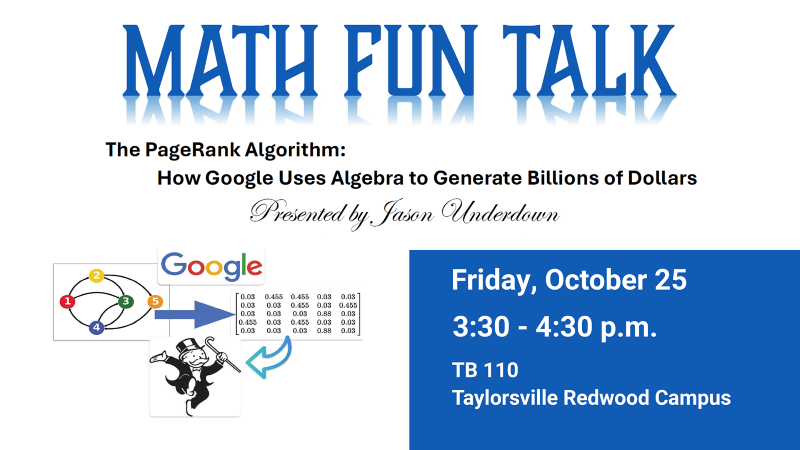
Event Description:
In 1998, Larry Page and Sergey Brin, the founders of Google revolutionized the search engine industry by fundamentally rethinking how to search for information on the web. While conventional search engines ranked results by counting how many times the search terms appeared on the page, they theorized about a better system that analyzed the relationships among websites. They called this algorithm PageRank; it determined a website's relevance by the number of pages, and the importance of those pages that linked back to the original site.
We will explore the PageRank algorithm three different ways:
- As a random walk on a graph.
- As a game where players give away all they own each turn.
- As a matrix which is repeatedly multiplied by itself.
The talk will end by briefly describing how to dramatically speed up the algorithm, and then use the PageRank algorithm to rank all college football teams and predict which teams have the best chance to win the 2025 CFP championship.